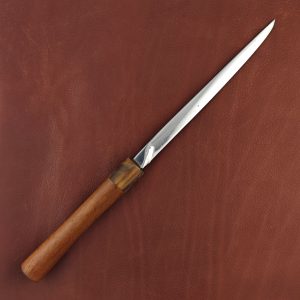
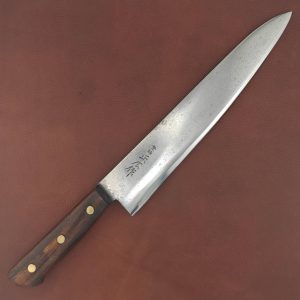
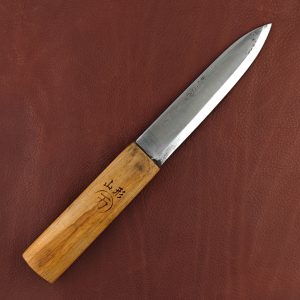
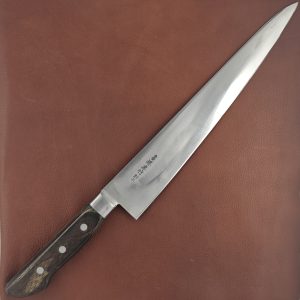
| Gyuto | 牛刀 | Chef's knife (gyuto) | Japanese take on the Western chef’s knife, the all-purpose blade for most everyday prep. | Double-bevel | General-purpose |
| Petty | ペティナイフ | Petty / paring knife | Small utility knife that covers paring work and the kind of small-scale tasks a short chef’s knife would do. | Double-bevel | General-purpose / small prep |
| Santoku | 三徳包丁 | Santoku (all-purpose home knife) | All-purpose home-kitchen knife with a shorter, taller blade that handles meat, fish, and vegetables. | Double-bevel | General-purpose |
| Bunka | 文化包丁 | Bunka (K-tip multipurpose) | Multi-purpose knife like a Santoku but with a taller blade and a K-tip point for finer tip work. | Double-bevel | General-purpose |
| Ko-Bunka | 小文化包丁 | Small bunka / compact bunka | Compact version of a Bunka for small boards or tight workspaces. | Double-bevel | General-purpose / small prep |
| Nakiri | 菜切り包丁 | Vegetable knife (nakiri) | Straight-edged vegetable knife for chopping and slicing produce on the board. | Double-bevel | Vegetables |
| Usuba | 薄刃包丁 | Single-bevel vegetable knife (usuba) | Single-bevel vegetable knife for pro-level, very precise vegetable work and garnishes. | Single-bevel | Vegetables / garnish |
| Kamagata Usuba | 鎌形薄刃包丁 | Kamagata usuba (Osaka-style) | Osaka-style usuba with a sickle-shaped tip, favored for detailed carving and garnish work. | Single-bevel | Vegetables / garnish |
| Kanto Usuba | 関東型薄刃包丁 | Kanto usuba (Tokyo-style) | Tokyo-style usuba with a squared-off tip, used as a straight-edged vegetable specialist. | Single-bevel | Vegetables |
| Kiritsuke | 切付包丁 | Traditional kiritsuke (head chef's knife) | Traditional single-bevel hybrid of usuba and yanagiba used by head chefs as an all-rounder for fish and vegetables. | Single-bevel | General-purpose (pro) / fish & veg |
| Kiritsuke-Yanagiba | 切付柳刃包丁 | Kiritsuke-tip sashimi knife | Single-bevel sashimi knife with a kiritsuke K-tip, combining yanagiba slicing with a sharper point. | Single-bevel | Fish / sashimi |
| Kiritsuke-Gyuto | 切付牛刀 | K-tip gyuto / chef's knife | Double-bevel gyuto with a K-tip, blending Western chef’s knife utility with a sharper, more aggressive point. | Double-bevel | General-purpose |
| Deba | 出刃包丁 | Deba (fish and butchery knife) | Thick, heavy single-bevel knife for breaking down and filleting whole fish and light butchery. | Single-bevel | Fish / butchery |
| Hon-Deba | 本出刃包丁 | Hon-deba (full deba) | Full-thickness, classic deba used by pros for head-off and filleting work on whole fish. | Single-bevel | Fish / butchery |
| Ai-Deba | 相出刃包丁 | Ai-deba (medium deba) | Slightly thinner, lighter deba that splits the difference between a full deba and a mioroshi for general fish work. | Single-bevel | Fish |
| Ko-Deba | 小出刃包丁 | Ko-deba (small deba) | Small deba for cleaning and filleting smaller fish where a full deba feels oversized. | Single-bevel | Fish / small fish |
| Mioroshi-Deba | 身卸出刃包丁 | Mioroshi deba (deba-sujihiki hybrid) | Longer, slimmer deba that can both break down and then slice fish in one knife. | Single-bevel | Fish / slicing |
| Funayuki | 舟行包丁 | Funayuki (boat knife / light deba) | Traditional boat knife, a lighter deba-like all-rounder for fish and basic prep on small boats. | Either (single or double) | Fish / light general prep |
| Ajikiri | 鯵切り包丁 | Ajikiri (small fish knife) | Compact fish knife, essentially a tiny deba for small fish like horse mackerel. | Single-bevel | Fish / small fish |
| Yo-Deba | 洋出刃包丁 | Yo-deba (Western deba) | Western-style, double-bevel deba used like a short, beefy chef’s knife for tough prep and butchery. | Double-bevel | Butchery / heavy prep |
| Honesuki | 骨スキ包丁 | Honesuki (poultry boning knife) | Japanese boning knife for taking apart whole chickens and working around joints and bones. | Single-bevel (often with back micro-bevel) | Poultry / butchery |
| Kaku-Honesuki | 角骨スキ包丁 | Kaku-honesuki (triangular honesuki) | Triangular, pointed honesuki used by pros to pop apart poultry joints with precise cuts. | Single-bevel | Poultry |
| Maru-Honesuki | 丸骨スキ包丁 | Maru-honesuki (curved honesuki) | Curved honesuki that tracks along bones and is often favored in Western-style butchery. | Either (single or double) | Poultry / butchery |
| Garasuki | ガラスキ | Garasuki (large honesuki) | Larger, heavier honesuki built for breaking down bigger birds and doing harder boning work. | Either (single or double) | Poultry / heavy butchery |
| Hankotsu | 半骨包丁 | Hankotsu (hanging meat knife) | Stout boning knife used to work close to bones and trim meat hanging on carcasses. | Double-bevel | Red meat / butchery |
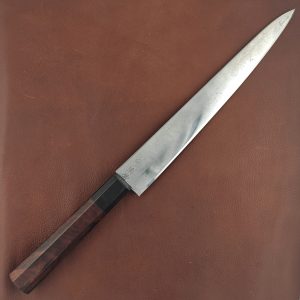
| Sujihiki | 筋引き包丁 | Sujihiki slicer / carving knife | Long, thin double-bevel slicer for carving roasts, proteins, and portioning fillets. | Double-bevel | Slicing / carving |
| Yanagiba | 柳刃包丁 | Yanagiba sashimi knife | Traditional single-bevel sashimi knife for pulling long, clean slices of raw fish. | Single-bevel | Fish / sashimi |
| Sakimaru Yanagiba | 先丸柳刃包丁 | Sakimaru yanagiba (rounded-tip sashimi knife) | Yanagiba with a rounded, katana-like tip that adds reach and showpiece flair for sashimi work. | Single-bevel | Fish / sashimi |
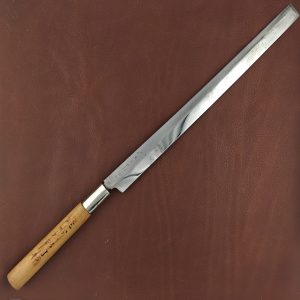
| Takohiki | 蛸引き包丁 | Takohiki sashimi knife | Rectangular-tipped sashimi knife favored in Tokyo for slicing sashimi and octopus with very flat pulls. | Single-bevel | Fish / sashimi |
| Fuguhiki | 河豚引き包丁 | Fuguhiki (fugu slicer) | Ultra-thin sashimi knife specialized for cutting paper-thin slices of fugu pufferfish. | Single-bevel | Fish / sashimi |
| Pankiri | パン切り包丁 | Bread knife (pankiri) | Japanese bread knife with a serrated edge for cleanly sawing through crusty loaves. | Double-bevel (serrated) | Bread / baked goods |
| Steak Knife | ステーキナイフ | Steak knife (table knife) | Table knife with a fine or serrated edge for cutting cooked steaks at the plate. | Double-bevel | Table / steak service |
| Menkiri | 麺切り包丁 | Noodle knife (menkiri) | Flat, tall knife used to chop rolled noodle dough into strands in one straight downward motion. | Double-bevel | Noodles / dough |
| Sobakiri | 蕎麦切り包丁 | Sobakiri (soba noodle knife) | Specialized menkiri for cutting soba noodles, usually paired with a wooden guide. | Double-bevel | Noodles / dough |
| Udonkiri | うどん切り包丁 | Udonkiri (udon noodle knife) | Heavy noodle knife for cutting thicker udon dough into wide noodles. | Double-bevel | Noodles / dough |
| Maguro-Bōchō | 鮪包丁 | Maguro-bōchō (tuna market knife) | Very long tuna knife used in fish markets to break down whole tuna with sweeping cuts. | Single-bevel | Fish / tuna breakdown |
| Oroshi-Bōchō | 卸し包丁 | Oroshi-bōchō (market breakdown knife) | Large market knife for butchers and fishmongers to break down whole animals or big fish. | Single-bevel | Butchery / market |
| Unagisaki | 鰻裂き包丁 | Unagisaki (eel knife) | Regional set of knives designed specifically for splitting and cleaning eel. | Single-bevel | Fish / eel |
| Hamo-Kiri | 鱧切り包丁 | Hamo-kiri (hamo bone-cutter) | Specialized knife for fine cross-cutting the many bones of pike conger (hamo) without severing the skin. | Single-bevel | Fish / hamo |
| Sakekiri | 鮭切り包丁 | Sakekiri (salmon knife) | Long, sturdy knife used for breaking down and portioning salmon. | Single-bevel | Fish / salmon |
| Mukimono | 剥き物包丁 | Mukimono (garnish carving knife) | Small single-bevel knife for decorative carving and intricate garnish work. | Single-bevel | Garnish / vegetables |
| Kurimuki | 栗むき包丁 | Kurimuki (chestnut peeler) | Short, strong peeler for cutting and peeling tough-skinned things like chestnuts. | Single-bevel | Peeling / garnish |
| Chukabocho | 中華包丁 | Chukabocho (Chinese-style cleaver) | Chinese-style rectangular cleaver used in Japanese kitchens as an all-purpose chopper and slicer. | Double-bevel | General-purpose / vegetables / meat |
| Kogatana | 小刀 | Kogatana (small utility knife) | Small utility blade used around the kitchen and workshop for odds-and-ends cutting tasks. | Either (single or double) | Utility / misc. |
| Kiridashi | 切り出し小刀 | Kiridashi (craft / marking knife) | Single-bevel craft knife more at home in woodworking and leather work but often seen alongside kitchen tools. | Single-bevel | Craft / utility |